
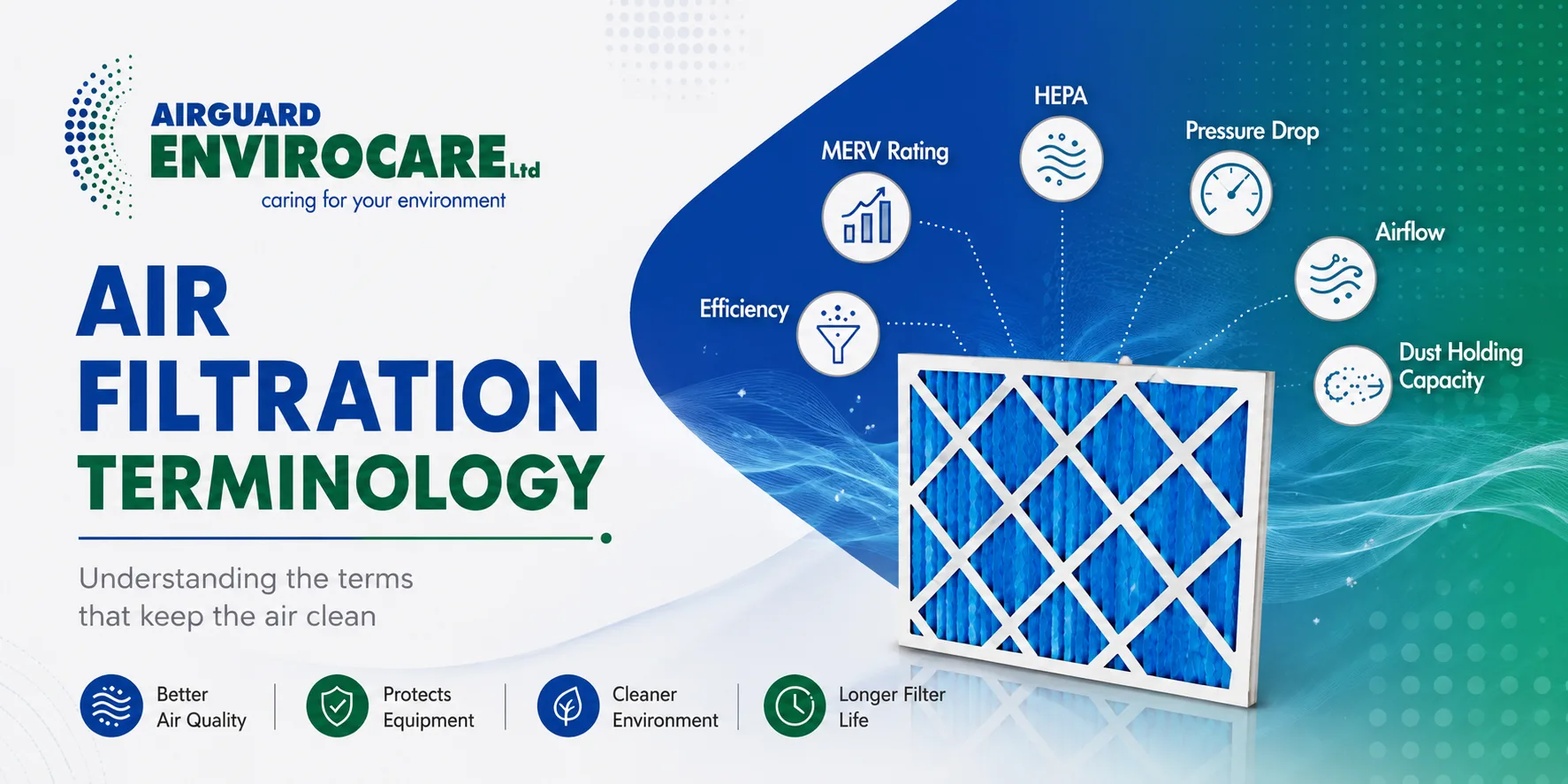
Getting to know the technical terms & industry lingo… If you’re unsure with the air filtration terminology you may require, it can be tricky getting past the technical terms and industry lingo.
Airguard Envirocare Limited makes sure we always talk your language plus, we’ve listed some of the most common terms used within the air filtration sector to help:
Activated Carbon
Activated carbon is a high-purity form of carbon commonly used in air filters to remove pollutants, odours, gases, and volatile organic compounds (VOCs). It absorbs these contaminants from the air, helping improve indoor air quality and creating cleaner, healthier environments.
Air Conditioning
This is the process of treating or altering air in an indoor space to maintain a comfortable and controlled environment. Adjustments include cooling, heating, ventilation, humidification, dehumidification and air purification.
Air Exchange Rate
The air exchange rate measures how often fresh outdoor air replaces indoor air within a space. Professionals typically express the air exchange rate as Air Changes per Hour (ACH) or Cubic Feet per Minute (CFM) to evaluate ventilation performance and indoor air quality.
Air Filter
An air filter removes airborne particles, contaminants, allergens, and pollutants from the air to improve indoor air quality. HVAC systems, air purifiers, and industrial ventilation systems use air filters to protect equipment, maintain clean airflow, and create healthier indoor environments.
Air Handling Unit
This is a component of heating, ventilation and air conditioning systems. Air handling units typically consist of a fan, heating and cooling elements, filters, and dampers, to circulate air throughout a building.
Air Pressure
Also known as atmospheric pressure, measures the force of air as it flows through a filtration system or ductwork. In air filtration systems, air pressure indicates how easily air passes through filters and equipment. As filters capture more contaminants, airflow resistance increases, resulting in a higher pressure drop and signalling that the filter may need maintenance or replacement.
Air Purifier
An air purifier is a device that cleans the air by drawing it through filters or other purification technologies. It helps reduce airborne contaminants such as dust, allergens, odours and pollutants before releasing cleaner air back into the space.
Air Quality
Air quality refers to the condition of the air in terms of the presence of pollutants, contaminants and other substances that may affect health and the environment.
Airborne Particles
Airborne particles are tiny solid or liquid particles that remain suspended in the air. These particles include dust, pollen, smoke, allergens, and industrial contaminants. Air filtration systems capture and remove these particles to improve indoor air quality, protect HVAC equipment, and create healthier indoor environments.
Allergen
An allergen is a substance that triggers an allergic reaction when people inhale it or come into contact with it. Common airborne allergens include pollen, dust mite particles, mould spores, and pet dander. Air filtration systems capture and reduce these allergens to improve indoor air quality and create healthier indoor environments.
Bacteria
Bacteria are single celled microorganisms. They range from beneficial and essential to life, to intensely harmful and even lethal.
Bag Filter
A bag filter is a type of filtration system that features a bag-shaped media to filter particulates from the air passing through the system.
Carbon Filter
This is a filtration system that uses activated carbon to remove pollutants, contaminants and other substances from the air.
Carbon Panel Filters
A carbon panel filter is another name for a carbon filter, denoting a panel-style filter with activated carbon as the filter media.
Cartridge
A cartridge is a replaceable filter element that fits within a filtration system. As air flows through the system, the cartridge captures contaminants and airborne particles. Regular replacement at the end of its service life ensures consistent filtration efficiency and optimal system performance.
C02
C02 is the abbreviation of carbon dioxide, a gas that is composed of two oxygen atoms bonded to a carbon atom.
Dust Holding Capacity
This is the amount of dust or particulate matter an air filter can retain before needing to undergo maintenance, cleaning, or replacement.
Energy Efficiency
Energy efficiency refers to how effectively an air filtration system operates while using minimal energy. Efficient systems reduce airflow resistance, helping fans and HVAC equipment run more economically.
EN779
EN779 is the European standard for classifying particulate air filters based on their filtration efficiency and dust holding capacity. This standard is commonly used in HVAC and air filtration applications.
Extractor Fan
An extractor fan is a mechanical fan designed to remove stale, contaminated or humid air from a space. It draws air out of an area and either vents it externally or directs it into a filtration system.
Filter Efficiency
Filter efficiency measures how effectively a filter removes airborne particles from the air. Manufacturers determine filter efficiency by comparing the number of particles before and after the air passes through the filter or by measuring the percentage of particles the filter captures. Higher filter efficiency indicates better filtration performance and improved indoor air quality.
Filter Frame
The filter frame composes the outside of a filter, holding and stabilising the filter media on a filter. Not all filters feature frames; panel filters, bag filters, and V-cell filters are examples of filters that feature frames.
Filter Grade
Filters are graded based on filtration efficiency and the particle size that the filter can capture. This is determined by industry standards, which break down efficiency into several classifications.
Filter Housing
Filter housing is the casing that holds air filters securely in place. It ensures air flows correctly through the filter media while protecting the filter and maintaining system performance.
Filter Lifespan
The filter lifespan refers to how long a filter remains effective before it requires replacement, based on its ability to maintain performance and efficiency in capturing particles.
Filter Mats
The Filter mats are manufactured from a filtration media and are suitable for applications where a frame is not required, including HVAC and spray booths, to remove pollutants from the air.
Filter Media
This is the material or substance used for filtration in a filter. The media traps and removes particles and other contaminants from the air. Different media material is available depending on the application and particulate size and type.
Final Pressure Drop
Final pressure drop is the maximum level of airflow resistance a filter reaches before it needs replacing. As contaminants build up in the filter, resistance increases and airflow performance reduces.
Grease Filter
A grease filter traps grease, smoke, and airborne oil particles generated during cooking. Commercial kitchens use grease filters to improve air quality, protect ventilation systems, and reduce the risk of grease buildup and potential fire hazards.
HEPA
HEPA stands for High Efficiency Particulate Air filter – referring to the efficiency of the filter. These filters capture up to 99.97% of airborne particles as small as 0.3 microns, helping improve indoor air quality in residential, commercial, and industrial environments.
Holding Capacity
Holding capacity is the amount of dust or particulate matter a filter can retain before reaching its final pressure drop. Filters with a higher holding capacity generally have a longer service life.
HVAC
The acronym HVAC is used for Heating, Ventilation and Air Conditioning, a system that adjusts the air in a room depending on temperature, humidity, and purity.
HVAC Filters
The HVAC filters are used within heating, ventilation and air conditioning systems to remove airborne particles from circulated air. They help protect equipment and maintain good indoor air quality.
Indoor Air Quality
Indoor air quality (IAQ) is the condition of the air in a specified place, focussing on the presence of pollutants, contaminants, and comfort levels of those occupying the indoor space.
ISO 16890
This is an international standard for testing and classifying air filters based on their efficiency in capturing particulate matter of different sizes. ISO 16890 has replaced the previous standard, EN779.
MERV
MERV stands for Minimum Efficiency Reporting Value. It is a rating system used to measure how effectively a filter captures airborne particles, with higher ratings indicating finer filtration.
Microfibre
A microfibre is an extremely fine synthetic fibre, known for its ability to trap and hold dust, dirt and liquids.
Panel Filters
Flat, rectangular filters consisting of pleated or non-pleated media enclosed within a frame, which can be made from cardboard, plastic or metal. Panel filters can be used within HVAC systems.
Paper Pleats
This refers to the folds made in paper-based filter media. The pleats increase surface area, improving the ability of the filter to capture particulates while maintaining a compact size.
Particle
A particle is a small piece of matter, either a solid or a liquid, that can vary in size, shape, and composition. Dust, pollen, and smoke are all types of particles.
Pleated Filter
Another type of filter, the pleated filter utilises pleated (folded) filter media encompassed within a frame. Also known as a pleated panel filter, the increased surface area of the pleated media traps particulates.
Pollution
Pollution refers to harmful substances present in the air that can affect health, processes or equipment. This can include dust, fumes, gases and other contaminants that air filtration systems aim to control.
Polyester
Polyester (PET) is a durable synthetic polymer. Air filter manufacturers use PET to produce high-performance filter media because it provides excellent strength, moisture resistance, and long-lasting filtration performance. Its strength, moisture resistance, and quick-drying properties make it an excellent material for air filtration applications that require long-lasting performance.
Pocket Filters
Pocket filters are a filter type known for its filter media which extends out from the frame, providing an increased surface area for an improved holding capacity.
Pre Filter
A pre-filter is the first stage of filtration in a multi-stage system. It captures larger particles before air reaches the main filter, helping to extend the life of the primary filter.
Rigid Bag Filter
A rigid bag filter uses bag-shaped filter media supported by a rigid metal or plastic frame. Commercial and industrial HVAC systems rely on rigid bag filters for their high dust-holding capacity, low pressure drop, and efficient airflow, making them ideal for demanding air filtration applications.
Spray Booth Filters
A spray booth filter captures overspray before it enters extraction systems in industrial spray booth applications. It uses specialised filter media to maintain clean airflow and support efficient filtration.
UGVI (Ultraviolet Germicidal Irradiation)
UVGI uses ultraviolet (UV) light to kill or inactivate microorganisms such as bacteria, viruses, and other pathogens. It disinfects air, water, and surfaces in residential, commercial, and industrial environments.
V Cell Filters
V cell filters, also known as rigid bag filters, feature filter media supported by a rigid frame that forms an open bag shape. This design provides a larger filtration surface area, improving dust-holding capacity and airflow efficiency.
Ventilation
The process of exchanging indoor air with outdoor or fresh, filtered air to improve air quality.
VOC (Volatile Organic Compounds)
Volatile Organic Compounds are organic chemicals that evaporate at room temperature, releasing gases in the air that can be dangerous or problematic to the environment, air quality, and human health.